Description of Incident
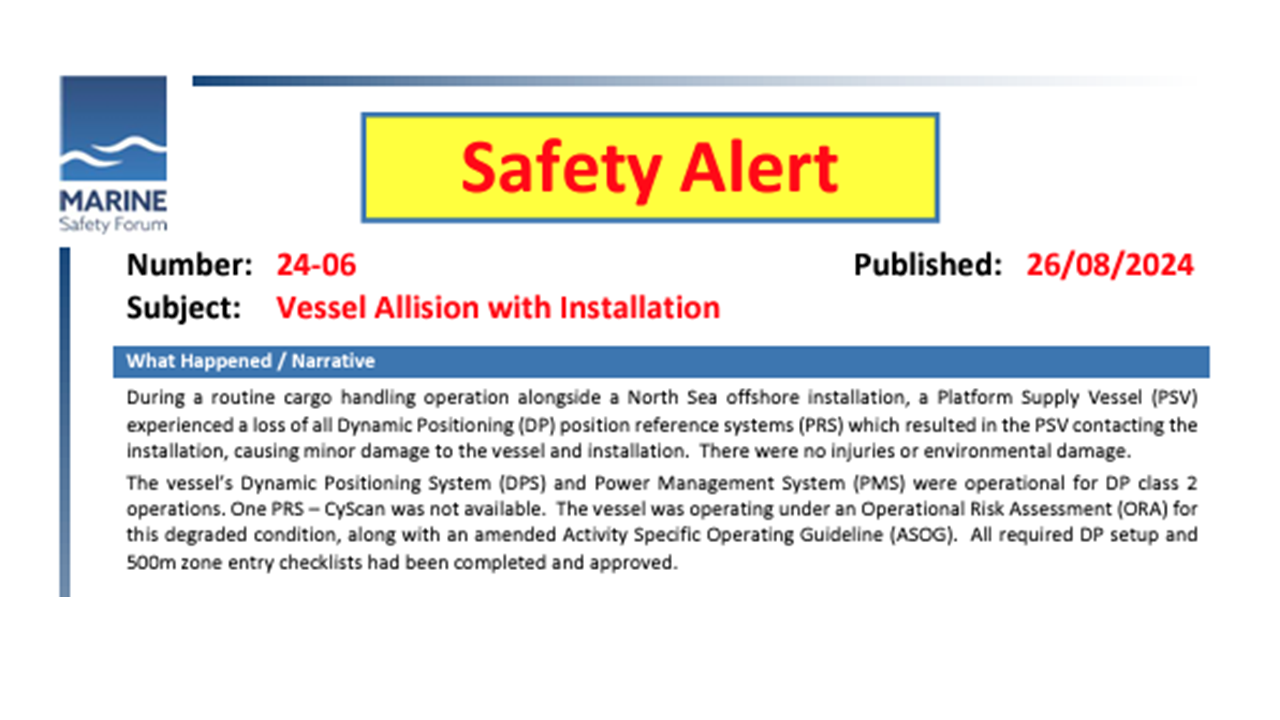
During a routine cargo handling operation alongside a North Sea offshore installation, a Platform Supply Vessel (PSV) experienced a loss of all Dynamic Positioning (DP) position reference systems (PRS) which resulted in the PSV contacting the installation, causing minor damage to the vessel and installation. There were no injuries or environmental damage. The vessel’s Dynamic Positioning System (DPS) and Power Management System (PMS) were operational for DP class 2 operations. One PRS – CyScan was not available. The vessel was operating under an Operational Risk Assessment (ORA) for this degraded condition, along with an amended Activity Specific Operating Guideline (ASOG). All required DP setup and 500m zone entry checklists had been completed and approved.
The vessel initially experienced Differential Global Navigation Satellite System (DGNSS) PRS signal instability. Before moving clear to investigate and stabilise the PRS, the DPO sent a RadaScan PRS responder via the crane to be installed on the installation as a second responder. The Master had not been informed of the developing situation as per the ASOG. At the standoff location the DGNSS signal stabilised and the DPO configured the RadaScan unit to ‘multi-target mode’ (interrogating both responders on the installation). The vessel commenced moving back into the working location to continue cargo operations.
As the vessel approached the working location alongside, both DGNSS and RadaScan signals were ‘lost’ and the online PRS were rejected by the DPS. Subsequently, the DPS entered Dead Reckoning (DR) mode (DR mode uses a mathematical model to estimate position for several minutes without input from PRS’s). The DPS calculated the ‘mathematical model’ position 3.4m to port of its current position and the deviation increasing up to approx. 8m (the model calculated the vessel to be off position by 3m and moving further away). The DPS attempted to reduce this calculated position ‘jump’ by thrusting the vessel to port (towards the installation).
The DPO visually observed the vessel’s position loss and the DPS ‘driving’ the vessel towards the installation and intervened by taking control of the DPS in joystick mode with auto-heading and attempted to move the vessel away from the Installation.
A combination of vessel momentum to port, swell direction and reduced thrust allocation for positioning (due to the joystick autoheading priority) resulted in the vessel contacting a jacket leg on the Installation.
The vessel exited the installation 500m zone to carry out a damage assessment and commence investigation.
To view this Marine Safety Forum safety alert in full, click the 'Download Alert' button above.
Rate this alert
Average Rating
Latest Alerts & Moments
Our searchable catalogue of hundreds of Safety Alerts and Safety Moments are all designed as learning resources that can help improve workplace safety.